A Journey Through Clay: Mapping the Enduring Art of Native American Pottery
Imagine a map, not of borders or highways, but of clay and fire, of ancestral hands shaping earth into vessels of life and spirit. This is the "Map of Native American Pottery Making," a conceptual journey across North America that reveals the profound historical depth, cultural identity, and artistic diversity embedded in indigenous ceramic traditions. Far more than a guide to where pottery was made, such a map charts the very pulse of communities, their ingenuity, their beliefs, and their enduring connection to the land. For the traveler seeking authentic cultural experiences and the student of history, understanding this map offers an unparalleled window into the vibrant tapestry of Native American heritage.
The Earth as Canvas: A Deep History of Innovation
The story of Native American pottery begins thousands of years ago, a testament to ingenious adaptation and artistic expression developed long before European contact. The earliest evidence of ceramic use in North America dates back to approximately 4,500 years ago in the American Southeast, predating the widespread adoption of pottery in many other parts of the continent. While some theories suggest the diffusion of pottery technology from Mesoamerica, archaeological evidence strongly supports independent invention and localized innovation across numerous distinct cultural areas.
Early pottery was utilitarian: vessels for cooking, storing food and water, and transporting goods. Over millennia, however, it evolved to encompass ceremonial objects, burial accompaniments, and intricate works of art. The "map" would show an initial spread from centers of innovation, followed by the development of unique regional styles, materials, and techniques dictated by local clay sources, available tempering agents, environmental conditions, and distinct cultural aesthetics. This evolution was not linear but a dynamic process of experimentation, refinement, and cultural exchange, leaving an indelible mark on the archaeological record and living traditions.
Regional Tapestries: Clay as Cultural Fingerprint
The true power of our pottery map lies in its ability to highlight the astonishing regional diversity, where each tradition acts as a distinct cultural fingerprint.
The Southwestern Hearth: Pueblo, Navajo, and Apache Traditions
Perhaps the most recognized region for its pottery, the American Southwest is a vibrant hub of ceramic artistry, primarily driven by the Pueblo peoples (Hopi, Zuni, Acoma, Santa Clara, San Ildefonso, Cochiti, etc.), alongside Navajo and Apache traditions. Here, pottery is not merely craft; it is an integral part of ceremonial life, community identity, and a direct link to ancient ancestors.
The earliest Southwestern pottery, such as the exquisite black-on-white ware of the Mimbres culture (c. 1000-1130 CE), showcased intricate geometric and zoomorphic designs, often ritually "killed" before burial. The ancestral Puebloans (Anasazi) developed sophisticated corrugated and black-on-white styles. As agricultural societies flourished, so did the diversity of pottery.
Pueblo Pottery: Each Pueblo village boasts unique styles, often passed down through matriarchal lines.
- Hopi: Known for yellow or orange slips and highly symbolic designs in black and red, often depicting migration patterns, clan symbols, and rain clouds. The use of traditional Sikyatki Revival styles, initiated by Nampeyo of Hano, is a cornerstone of modern Hopi pottery.
- Zuni: Characterized by designs featuring deer with "heartline" arrows, often in dark brown or black on a white slip, with geometric patterns.
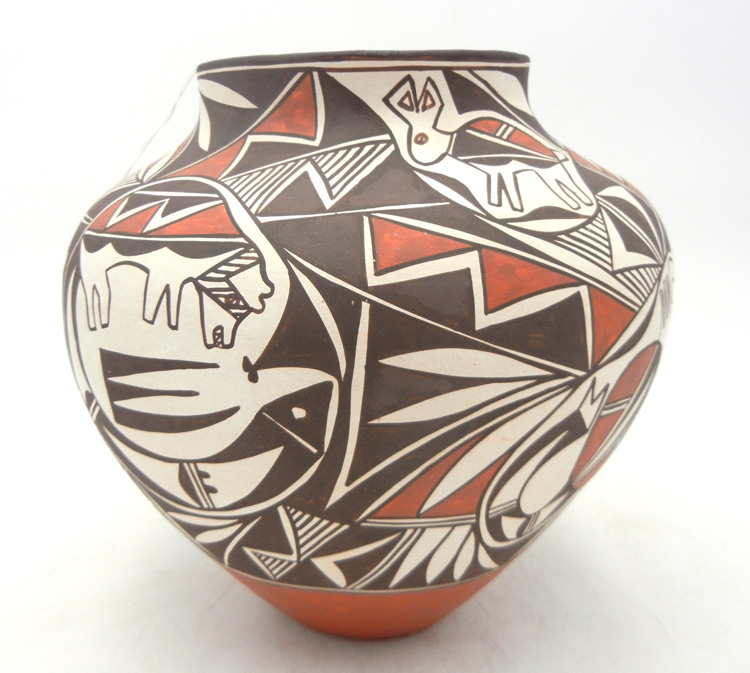
- Acoma: Famous for incredibly thin-walled, lightweight vessels adorned with bold geometric patterns, often depicting parrots or floral motifs, in black and orange on a white background.
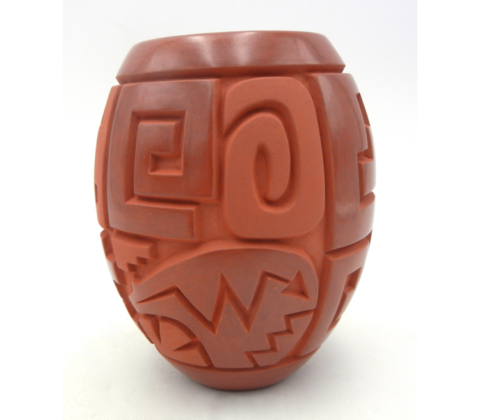
- San Ildefonso and Santa Clara: Celebrated for their polished blackware, a technique perfected by Maria Martinez and Julian Martinez in the early 20th century, where matte designs contrast against a lustrous, stone-polished surface. Redware and polychrome styles are also prevalent.
- Cochiti: Known for whimsical storyteller figures, a tradition started by Helen Cordero, depicting elders telling stories to children.

Navajo and Apache Pottery: While less dominant than Pueblo traditions, Navajo and Apache pottery, often unpainted and used for utilitarian purposes, possesses its own distinct character. Navajo wedding vases, with their double spouts, symbolize the unity of two lives. Apache pottery, typically coil-built and sometimes sealed with pine pitch, reflects their nomadic or semi-nomadic lifestyles.
The Southwestern map section would highlight the specific clay types (e.g., micaceous clay for Taos and Picuris), tempering agents (sand, volcanic ash, crushed potsherds/grog), firing methods (open pit, reduction firing for blackware), and the deep symbolism of painted designs that narrate creation stories, honor ancestors, and invoke blessings for rain and abundant harvests.
The Southeastern Mounds: Mississippian and Woodland Traditions
Moving eastward, the map would trace pottery traditions back to the Woodland (c. 1000 BCE – 1000 CE) and Mississippian (c. 800-1600 CE) periods, particularly in the fertile river valleys of the Southeast. This region saw the development of complex mound-building societies, and their pottery reflects this sophistication.
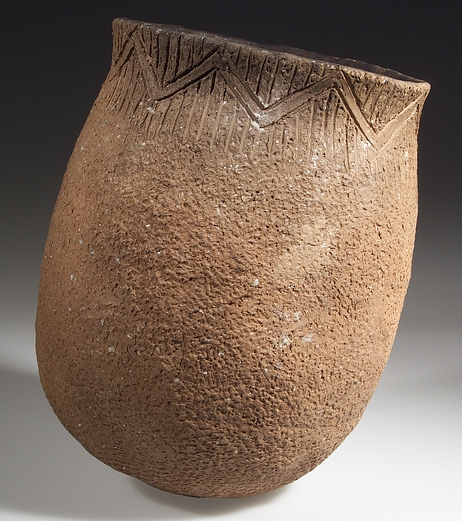
Early Woodland pottery often featured textile or cord impressions, reflecting the use of baskets as forms or fabric-wrapped paddles. As cultures evolved, so did their ceramic artistry. Mississippian pottery is renowned for its diverse forms, often featuring effigy vessels depicting animals (owls, frogs, ducks), human heads, or anthropomorphic figures. Shell tempering—the inclusion of crushed mussel shells in the clay—was a widespread and highly effective technique, producing durable, thin-walled vessels.
Key features:
- Effigy Pots: Zoomorphic and anthropomorphic forms, often linked to spiritual beliefs and funerary practices.
- Incised and Engraved Designs: Intricate patterns, spirals, and cross-hatching, often symbolizing cosmological concepts or social hierarchies.
- Negative Painting: A technique where designs are created by resisting areas during painting, common in the Moundville culture.
- Caddoan Pottery: From the Arkansas/Louisiana/Texas region, Caddo pottery is exceptional for its finely engraved, highly polished wares, often with geometric patterns or naturalistic motifs.
The Southeastern section of the map would illustrate trade routes along major rivers, showing how pottery styles and tempering agents diffused, creating a dynamic network of cultural exchange among groups like the Cherokee, Choctaw, Chickasaw, Creek, and Seminole, whose descendants continue these traditions today, albeit often with modern adaptations.
The Northeastern Woodlands: Iroquois and Algonquian Adaptations
In the Northeast, pottery traditions often reflect a more semi-sedentary or nomadic lifestyle, though significant agricultural communities also existed. Woodland period pottery here is typically coil-built, often tempered with grit (crushed rock) or shell, and less frequently painted than Southwestern wares.
Iroquoian Pottery: Distinctive for its collared rims, often decorated with incised geometric patterns, punctates, and sometimes castellations (pointed projections) around the rim. The forms were generally utilitarian, designed for cooking and storage.
Algonquian Pottery: Exhibited a wider variety of forms and decorative techniques, including cord-marking (impressions from cord-wrapped paddles), dentate stamping (comb-like impressions), and incising. Designs were often simpler, reflecting regional variations.
The Northeastern "map" would show how pottery styles were influenced by available clay sources, the need for robust vessels for seasonal movements, and the use of tools like bone or wood for decoration. While not as extensively preserved or widely practiced today as Southwestern traditions, archaeological finds provide a rich understanding of these resilient cultures.
Other Regions: Diverse Approaches to Clay
- Great Plains: While basketry and hide work were more dominant, some Plains tribes, particularly those with more sedentary, agricultural lifestyles like the Mandan, Hidatsa, and Arikara, produced utilitarian pottery. These were often globular, wide-mouthed, and sometimes cord-marked, reflecting their village life along river systems.
- California: Many Californian tribes, such as the Cahuilla, Luiseño, and Kumeyaay, developed coil-built, unpainted, often reddish-brown utilitarian pottery. Their vessels, while simpler in form and decoration than those of the Southwest, were essential for seed gathering, cooking, and water storage, showcasing localized adaptations to abundant natural resources.
- Pacific Northwest: This region is unique for its relative absence of widespread pottery traditions, largely due to the abundance of wood, bark, and basketry materials that served similar functions. The rich cedar forests provided exceptional resources for containers, and stone boiling was a common cooking method, negating the need for fire-resistant clay pots. This absence, too, would be a critical feature on our map, illustrating how culture and environment dictate technological choices.
Techniques and Materials: The Language of Clay
Underlying the visual diversity of Native American pottery is a shared mastery of fundamental ceramic techniques, each adapted to local resources and cultural aesthetics.
- Clay Sourcing: Potters meticulously selected local clays, often traveling significant distances to find deposits with desired qualities. The color, plasticity, and workability of the clay were paramount. In many traditions, clay was (and still is) considered a living entity, gathered with prayer and respect.
- Preparation: Raw clay was processed by hand-grinding, sifting, and winnowing to remove impurities.
- Tempering: Crucial for preventing cracking during drying and firing, tempering involved adding non-plastic materials to the clay. Common tempering agents included:
- Sand or Grit: Crushed quartz, granite, or other rock.
- Shell: Crushed mussel or snail shells, common in the Southeast and parts of the Midwest.
- Grog: Pulverized pieces of broken pottery.
- Volcanic Ash or Mica: Used in specific regions for unique properties and aesthetics.
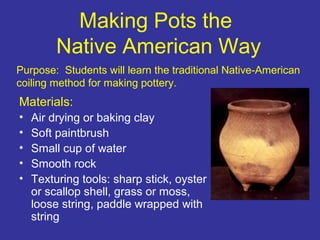
- Construction: The dominant method was coiling, where ropes of clay are spiraled upwards and then smoothed together. Pinching (for small vessels) and paddle-and-anvil (where an internal stone anvil supports the wall while an external paddle shapes and thins the pot) were also common.
- Shaping and Finishing: After construction, vessels were carefully scraped, smoothed, and often polished with a stone (slip-polishing) to create a lustrous surface.
- Surface Decoration:
- Slip: A thin coating of refined clay applied to the surface, often a different color, to create a smooth, even ground for painting or to enhance durability.
- Painting: Mineral-based pigments (iron oxides for reds, manganese for blacks, vegetal paints) were applied with yucca brushes or chewed sticks. Designs were often geometric, zoomorphic, or symbolic.
- Incising/Engraving: Cutting lines into the wet or leather-hard clay.
- Stamping: Pressing carved paddles, stamps, or textile into the wet clay.
- Cord Marking: Wrapping a cord around a paddle and impressing it onto the surface.
- Firing: Most pre-contact Native American pottery was fired in open pits or shallow trenches, reaching temperatures of 600-900°C (1100-1650°F). The type of fuel (wood, dung) and the amount of oxygen controlled the color of the final product (oxidized firing for reds/buffs, reduction firing for grays/blacks).
Each step, from gathering clay to the final firing, was often imbued with spiritual significance, a dialogue between the potter, the earth, and the ancestors.
Identity, Story, and Resilience: More Than Just Pots
The "Map of Native American Pottery Making" transcends mere geography and technique; it charts the very essence of identity, storytelling, and cultural resilience.
- Storytelling and Symbolism: Every design, every form, every color often holds a narrative or a symbolic meaning. A Pueblo design might represent a cloud, a prayer for rain, or a clan lineage. A Southeastern effigy pot might embody an ancestral spirit or a mythological creature. These vessels are tangible links to worldview, spiritual beliefs, and communal history.
- Ancestral Connections: Pottery styles and techniques are often passed down through generations, connecting contemporary potters directly to their ancestors. A potter might learn from their grandmother, who learned from her mother, creating an unbroken chain of knowledge and tradition. This lineage is a powerful affirmation of identity and belonging.
- Community and Collaboration: Pottery making was often a communal activity, with families and communities sharing knowledge, resources, and labor. The clay itself, gathered from communal lands, reinforced these bonds.
- Economic and Trade Significance: From ancient times, pottery was a vital trade commodity, facilitating cultural exchange and economic networks across vast distances. Today, Native American pottery continues to be a significant economic driver for many communities, allowing artists to sustain their families while preserving their heritage.
- Cultural Resilience: Despite centuries of colonization, forced assimilation, and cultural suppression, Native American pottery traditions have endured. The revival of specific techniques, the innovation of new forms, and the commitment of contemporary artists are powerful statements of cultural survival and revitalization. Each pot crafted today is an act of self-determination and a testament to an unbroken heritage.
The Map as a Living Educational Tool
For the discerning traveler and the history enthusiast, our "Map of Native American Pottery Making" is not an artifact of the past, but a living, breathing guide to understanding vibrant contemporary cultures. It encourages:
- Ethical Tourism: By understanding the origins and significance of pottery, visitors can seek out and support authentic Native American artists directly, ensuring their patronage benefits the communities whose heritage they are appreciating.
- Deepened Appreciation: Moving beyond surface-level aesthetics, the map allows for an appreciation of the skill, knowledge, and spiritual depth embedded in each piece.
- Historical Empathy: It offers a tangible connection to ancient civilizations, providing insights into their daily lives, spiritual practices, and artistic achievements.
- Engagement with Living Cultures: The map isn’t just about museums; it points to cultural centers, artist studios, and annual markets (like Santa Fe Indian Market or Heard Museum Guild Indian Fair & Market) where these traditions thrive today.
In conclusion, the "Map of Native American Pottery Making" is an invitation to explore a profound and multifaceted aspect of indigenous North American heritage. It is a testament to human ingenuity, artistic expression, and the enduring power of culture to shape and define identity. From the ancient coils of the Southwest to the shell-tempered effigies of the Southeast, each pot, each shard, tells a story—a story of earth, fire, and the unbreakable spirit of a people. To truly see this map is to embark on a journey not just across lands, but through time, spirit, and the enduring legacy of human creativity.

