
A Tapestry of Identity: Mapping Native American Beadwork Designs Across North America
Imagine a map, not of rivers and mountains, but of intricate patterns, vibrant colors, and whispered histories. This is the "Map of Native American Beadwork Designs," a profound cultural landscape where every stitch, every bead, tells a story of identity, resilience, and connection to the land. Far more than mere decoration, beadwork across Indigenous North America is a sophisticated visual language, a living archive of tribal sovereignty, spiritual beliefs, and personal narratives. For the discerning traveler and history enthusiast, understanding this map offers an unparalleled window into the soul of a continent’s original inhabitants.
This article will navigate the diverse territories of Native American beadwork, exploring its deep historical roots, its transformation through contact, and its enduring role in defining and preserving distinct tribal identities. We will journey from the ancient origins of indigenous adornment to the explosion of glass bead artistry, uncovering the unique stylistic "dialects" that emerge across different regions and nations.
The Ancestral Canvas: Pre-Contact Adornment and Early Materials

Before the arrival of European glass beads, Indigenous peoples across North America adorned themselves and their belongings with materials sourced directly from their environment. This pre-contact period laid the foundational aesthetic and technical principles that would later embrace new materials. Porcupine quills, often dyed with natural pigments from roots, berries, and minerals, were a primary medium. These quills were softened, flattened, and then wrapped, plaited, or sewn onto hides to create stunning geometric and pictorial designs. Quillwork, an art form requiring immense patience and skill, produced intricate patterns that shimmered with an organic luster.
Shells, particularly dentalium, wampum (quahog and whelk shells), and abalone, were also highly prized for their beauty and spiritual significance. Wampum, meticulously crafted into cylindrical beads, held immense ceremonial, diplomatic, and historical value among Northeastern Woodlands tribes like the Haudenosaunee (Iroquois) and Algonquian nations. Wampum belts served as mnemonic devices, recording treaties, alliances, and significant historical events, embodying the collective memory and political power of a people. Bone, seeds, claws, teeth, and copper were further utilized, each material carrying its own inherent meaning and contributing to a rich tapestry of personal and community expression. The designs from this era often reflected the natural world—animals, plants, celestial bodies—and spiritual concepts, establishing a visual vocabulary that would persist for centuries.
The Great Transformation: Glass Beads and a New Era of Artistry
The arrival of European traders brought a revolutionary material to Indigenous artisans: glass beads. Initially introduced as trade goods in the 16th century, these colorful, durable, and relatively inexpensive beads quickly captivated Indigenous communities. By the 18th and 19th centuries, glass beads had largely supplanted quills as the dominant decorative medium in many regions, ushering in an unprecedented era of artistic innovation.

This shift was not merely a change in material; it was a cultural and artistic renaissance. Glass beads offered a palette of colors far more extensive and vibrant than natural dyes, allowing for bolder designs and finer details. While initially seen as a trade commodity, Indigenous artists quickly adopted, adapted, and elevated glass beadwork into a distinct and powerful art form, applying traditional design principles to this new medium. The availability of beads also meant that more items could be embellished, from clothing and moccasins to bags, pipe stems, and ceremonial regalia, profoundly impacting visual culture and personal expression.
Mapping the Styles: Regional Dialects of Beadwork
The "Map of Native American Beadwork Designs" truly comes alive when we examine the distinct regional styles that emerged, each reflecting unique cultural practices, environmental influences, and historical trajectories.
The Great Plains: Bold Geometry and Narrative Power

The beadwork of the Great Plains nations—including the Lakota, Cheyenne, Crow, Blackfeet, and Comanche—is perhaps the most widely recognized, characterized by its bold geometric patterns, vibrant colors (often contrasting blues, reds, whites, and yellows), and the distinctive "lazy stitch" technique. In lazy stitch, rows of beads are strung on a thread and then tacked down to the hide in short segments, creating a ribbed, slightly raised texture.
Plains beadwork is deeply symbolic, often depicting cosmological maps, natural phenomena (like stars, lightning, mountains), or animal motifs (buffalo, eagle, bear). Designs could signify tribal affiliation, individual achievements in battle or hunting, or spiritual visions. For example, certain patterns might represent a specific warrior society or a personal guardian spirit. Beaded items like war shirts, moccasins, pipe bags, and cradleboards were not just beautiful; they were powerful objects imbued with meaning, identity, and protection. The history of Plains beadwork is intertwined with nomadic life, the buffalo hunt, and the later struggles for land and sovereignty, with beadwork becoming a vital means of cultural preservation during the reservation era.
The Northeast Woodlands: Curvilinear Elegance and Floral Abundance
In stark contrast to the Plains, beadwork from the Northeast Woodlands (Haudenosaunee, Ojibwe, Penobscot, Huron-Wendat) is renowned for its curvilinear, often naturalistic floral and vine motifs. Utilizing a "contour" or "overlay" stitch, beads are sewn individually or in short lines directly onto a fabric or hide background, allowing for fluid, intricate forms that mimic the natural world of the forest.
Common designs include intertwined vines, delicate blossoms, leaves, and berries, frequently rendered in muted, earthy tones alongside vibrant blues, reds, and purples. These designs often carry deeper symbolic meanings related to medicinal plants, the cycle of life, and connection to the earth. Objects like moccasins, gauntlets, pouches, and clothing were adorned, often with designs passed down through generations within families or clans, serving as potent markers of clan identity and cultural heritage. The artistry here reflects a deep reverence for the forest environment and a tradition of intricate basketry and quillwork that influenced the curvilinear aesthetics of beadwork.
The Plateau Region: A Confluence of Styles
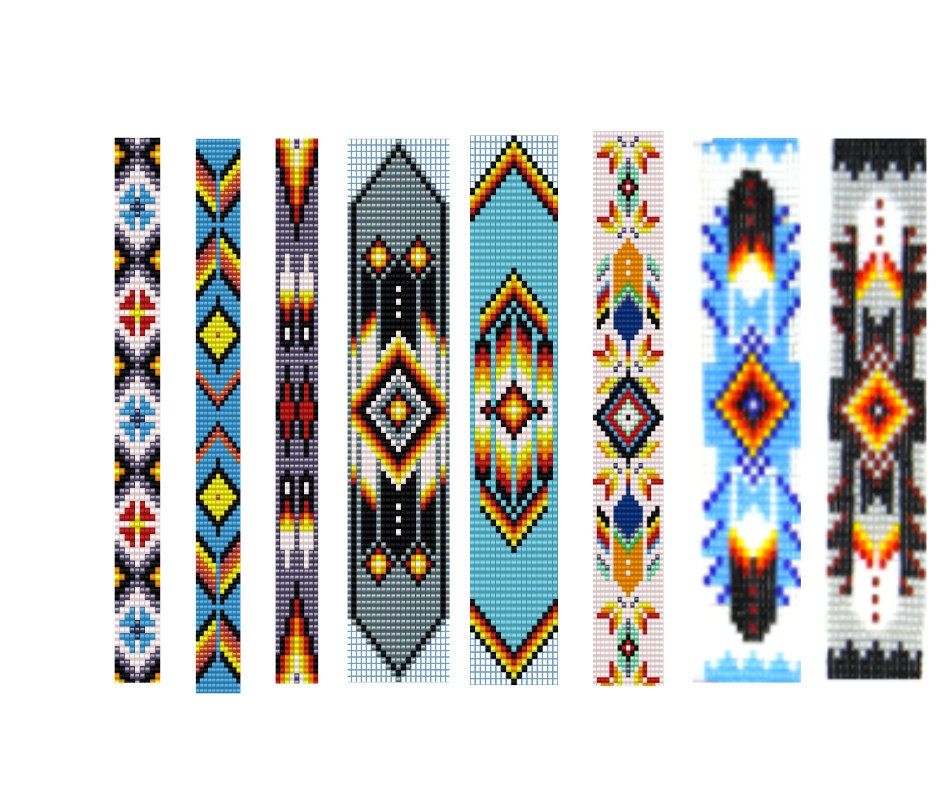
The Plateau region, encompassing tribes like the Nez Perce, Umatilla, and Yakama, sits geographically and culturally between the Plains and the Pacific Northwest, and its beadwork reflects this confluence. Here, one finds a beautiful integration of bold geometric patterns reminiscent of the Plains, alongside delicate floral designs akin to those of the Woodlands. Often, Plateau beadwork features a distinct "white background" style, where intricate designs "float" on a field of white beads, creating a striking visual effect.
Moccasins, bags, and horse regalia are common beaded items. The designs often tell stories of the Columbia River, salmon, and the mountainous terrain, blending abstract forms with recognizable natural elements. The meticulousness and vibrant palette of Plateau beadwork underscore a rich cultural exchange and adaptation, showcasing how artistic traditions can interweave and evolve.
The Southwest: Integrated Adornment and Earthy Tones
Beadwork in the American Southwest, home to the Navajo, Apache, and various Pueblo nations, often takes a different form. While not as dominant as a primary art form compared to weaving, pottery, or silversmithing, beads are intricately integrated into other cultural expressions. Smaller, often seed beads, are used to embellish textiles, leather goods, and ceremonial attire. The color palette tends to be more subdued, reflecting the desert landscape, with a prevalence of turquoise, red, black, and white.
Designs often incorporate geometric patterns, stepped motifs, and representations of natural elements like mountains, clouds, and corn, deeply connected to agricultural cycles and spiritual beliefs. Peyote stitch, a popular off-loom beading technique where beads are built up in rows, often in a circular fashion, is particularly prevalent in ceremonial items and jewelry, especially among Apache and Ute communities, linked to spiritual practices. Here, beadwork serves to enhance and complement, adding texture and color to an already rich visual tradition.
The Pacific Northwest Coast: Complementary Embellishment
On the Pacific Northwest Coast, where monumental carving, weaving, and painting dominate the artistic landscape, beadwork traditionally played a more complementary role. Instead of being the primary design element, beads were often incorporated into textiles like button blankets (where mother-of-pearl buttons form the primary design) or woven cedar bark hats, adding sparkle, texture, and highlights to existing formline art.
When used, beads often outline carved designs or add accents to ceremonial regalia, reflecting the complex animal crests and ancestral figures central to Haida, Tlingit, Kwakwaka’wakw, and Salish cultures. The emphasis remains on the powerful, flowing lines and symbolic animal representations, with beads enhancing their visual impact rather than creating the primary image.
Identity, Storytelling, and Cultural Resilience
Beyond aesthetics, the "Map of Native American Beadwork Designs" is a profound testament to identity and storytelling. Each pattern, color choice, and technique can signal tribal affiliation, clan membership, or even individual status. A young woman’s beaded cradleboard might incorporate designs passed down through her mother’s line, connecting her to generations of ancestors. A warrior’s beaded vest could display symbols of his bravery and specific spiritual protectors.
During periods of intense cultural suppression, such as the reservation era and forced assimilation policies, beadwork became a crucial act of cultural resistance and survival. It allowed Indigenous peoples to maintain connections to their heritage, transmit knowledge across generations, and express their distinct identities when other forms of cultural expression were forbidden. Beadwork became a source of economic sustenance, with women often selling their intricate creations to support their families, even as these pieces carried deep personal and communal significance.
Today, Native American beadwork continues to thrive as a living art form. Contemporary artists honor traditional techniques and designs while also innovating, incorporating modern influences and addressing contemporary issues. Beadwork is proudly worn at powwows, ceremonies, and cultural events, serving as a vibrant declaration of Indigenous presence, pride, and continuity. Museums worldwide showcase historical and contemporary pieces, educating global audiences about the sophistication and beauty of this art.
Conclusion: A Living Map of Heritage
The "Map of Native American Beadwork Designs" is not a static document but a dynamic, ever-evolving landscape of human creativity and cultural resilience. It invites us to look beyond the surface beauty of the beads and delve into the profound histories, spiritual beliefs, and enduring identities they represent. Each regional style, from the geometric power of the Plains to the floral elegance of the Woodlands, the integrated adornment of the Southwest, and the complementary embellishment of the Pacific Northwest, offers a unique window into the worldview of its creators.
For anyone traveling through North America or seeking a deeper understanding of its rich Indigenous heritage, engaging with Native American beadwork is an essential journey. It encourages respect for diverse cultures, appreciation for intricate artistry, and recognition of the power of visual language to preserve and transmit identity through generations. To truly see this map is to witness the enduring spirit of a people, expressed in every brilliant, carefully placed bead. Seek out Indigenous artists, visit cultural centers, and allow the stories woven into these designs to guide your understanding of a continent’s original and most vibrant art forms.

