
Journey to the Heart of the Sacred: Navigating Ancient Maps at Chaco Culture National Historical Park
Forget the glossy brochures and curated itineraries. There are journeys that transcend mere sightseeing, beckoning us to step onto terrain hallowed by millennia of human presence and profound spiritual intent. One such journey leads to the desolate, breathtaking expanse of Chaco Culture National Historical Park in New Mexico – not merely a collection of ruins, but a living testament to Native American maps of sacred gathering places, etched into the very landscape by the ancestral Puebloan people. This isn’t a "destination" in the conventional sense; it’s an encounter, a pilgrimage, and a profound lesson in respect for a civilization whose connection to the land and sky shaped their entire existence.
To speak of "maps" in the context of Chaco is to understand them not as paper diagrams, but as an intricate, interconnected web of physical pathways, astronomical alignments, and spiritual knowledge. The ancestral Puebloans, flourishing between 850 and 1250 AD, engineered an architectural and ceremonial marvel in this remote high desert canyon. Chaco Canyon became the epicenter of a vast regional system, a nodal point where people converged from across the Four Corners region for ceremonies, trade, and communal endeavors. Their "maps" were embedded in the landscape itself: the monumental Great Houses, the precise alignments with celestial events, and the extensive network of roads that radiated out from the canyon, connecting it to over 150 outlying communities.
Approaching Chaco is an experience in itself. The drive along unpaved, dusty roads through the vast, quiet New Mexico desert immediately signals that you are entering a place apart. The landscape is stark, beautiful, and unforgiving, demanding a certain humility from the outset. There are no bustling towns nearby, no Starbucks on the corner. Just the land, the sky, and the echoes of those who lived here. This isolation is crucial to the Chaco experience; it forces a slowing down, an internal quietude that prepares you for the deep history you are about to encounter.
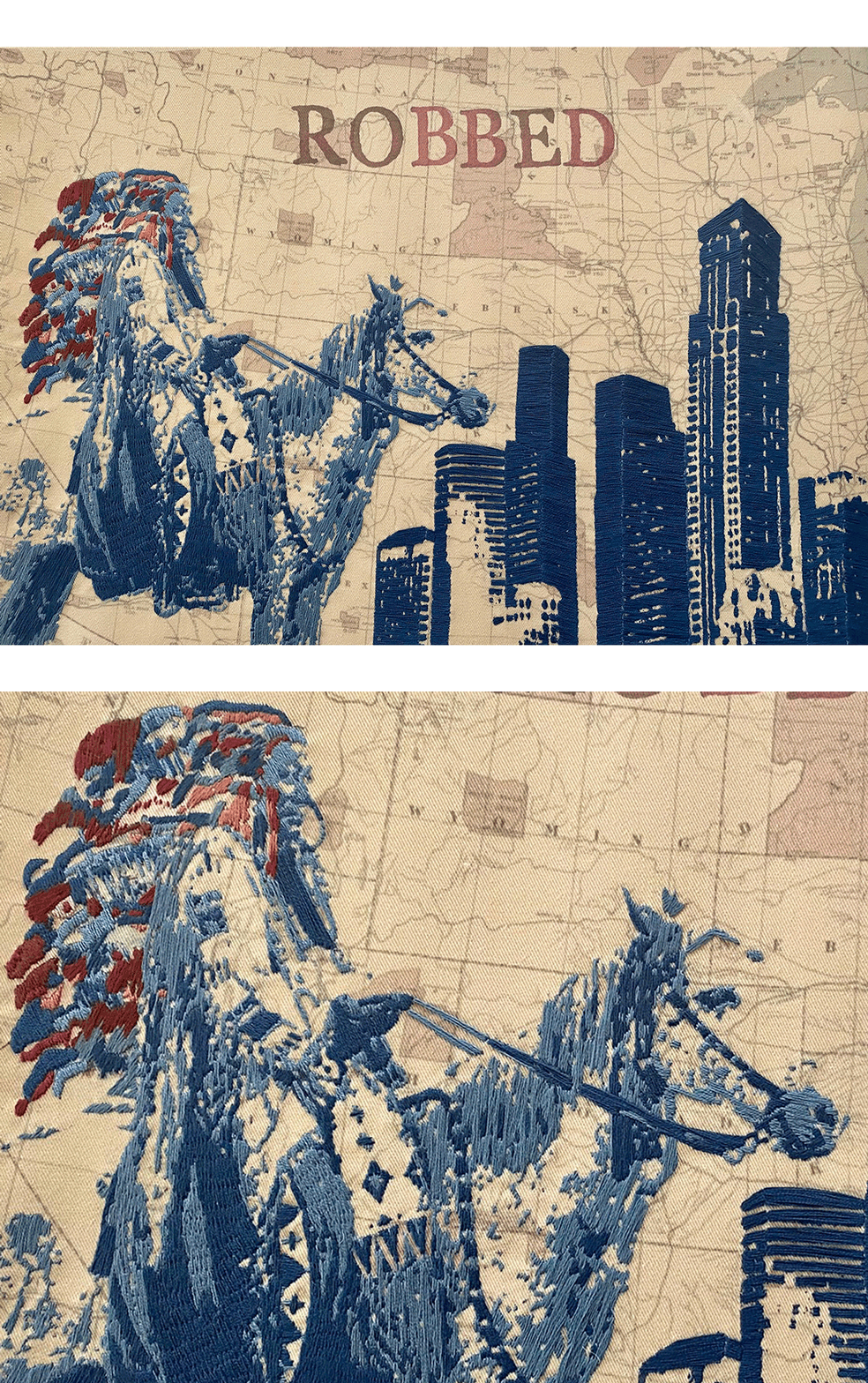
Upon arrival, the scale of Chaco’s achievements begins to unfold. The canyon floor, carved by an intermittent stream, cradles the remains of twelve major Great Houses. These aren’t mere dwellings; they are massive, multi-story masonry structures, some containing hundreds of rooms, meticulously constructed with millions of hand-cut sandstone blocks. Pueblo Bonito, the largest and most famous, is a D-shaped marvel covering nearly three acres, its walls reaching four stories high in places. Walking through its kivas – circular, subterranean ceremonial chambers – one feels an immediate sense of gravity. These were spaces for gathering, for prayer, for connecting with the spiritual world. The sheer precision of their construction, the deliberate alignments with solstices and equinoxes, speaks volumes about a people deeply attuned to the rhythms of the cosmos. The "map" here isn’t just terrestrial; it’s celestial, integrating the movements of the sun, moon, and stars into their sacred architecture.
The concept of sacred gathering places becomes tangible as you move between these Great Houses. Chetro Ketl, Kin Kletso, Una Vida – each possesses its own distinct character, yet all share the common thread of monumental scale and ceremonial purpose. Imagine thousands of people converging here, perhaps for the summer solstice, traveling along those ancient roads, bringing goods, knowledge, and prayers. The canyon would have thrummed with activity, yet always underpinned by a sense of shared spiritual purpose. These places were nodes on a vast, living map, facilitating interaction, reinforcing social bonds, and allowing for the collective experience of the sacred.
Perhaps the most compelling evidence of these "maps" are the Chacoan roads. These aren’t casual trails; they are remarkably straight, wide pathways, often several meters across, deliberately engineered across challenging terrain, sometimes requiring stairways cut into solid rock. Over 400 miles of these ancient roads have been identified, connecting Chaco Canyon to distant communities. While their exact purpose is still debated, it is widely believed they served as ceremonial routes, facilitating pilgrimage and the movement of goods and people for ritual gatherings. Standing at a point where a Chacoan road disappears into the horizon, one can almost visualize the ancient travelers, their minds set on the spiritual heart of the canyon, following a path known and revered for generations. These roads represent a physical manifestation of a sacred network, a map of connections across a vast landscape.
Visiting Chaco demands more than just a camera and comfortable shoes; it requires an open mind and a reverent heart. This is not a place for casual selfies and superficial observation. It is a place for quiet contemplation, for listening to the wind, for feeling the immense weight of history. The National Park Service has done an exemplary job of preserving the site while providing educational resources. The visitor center offers insightful exhibits, and ranger-led tours provide invaluable context, bringing the stones to life with stories and archaeological interpretations. However, the most profound learning happens when you allow yourself to simply be in the space, to walk the paths, to sit within the kivas, and to imagine the lives that unfolded here.

Preparing for Your Journey: A Guide to Respectful Engagement
To truly experience Chaco as a sacred gathering place, preparation is key:
- Mental and Spiritual Readiness: This is paramount. Read extensively about the ancestral Puebloans, their culture, their cosmology, and the significance of Chaco before you go. Understand that you are visiting a site of immense spiritual importance to their descendants, many of whom still live in the region. Approach with humility and respect.
- Physical Preparation: Chaco is remote. There is no cell service in much of the park, and amenities are minimal. Bring ample water (more than you think you’ll need), food, sun protection (hat, sunscreen), and sturdy hiking shoes. Temperatures can swing dramatically, so layered clothing is wise. Fuel up your vehicle before heading in, as gas stations are far away.
- Respect the Landscape and Artifacts: Stay on marked trails. Do not climb on walls, touch artifacts, or disturb any part of the site. Leave no trace of your visit. This is not just park rules; it is an ethical imperative. The preservation of Chaco relies on every visitor’s commitment to protecting its fragile heritage.
- Embrace the Quiet: Chaco is a place of profound silence. Let that silence wash over you. It allows for a deeper connection to the past and a greater appreciation for the natural environment. Resist the urge to fill the space with noise.
- Night Sky Viewing: Chaco is an International Dark Sky Park. If possible, stay overnight at the small campground. The unpolluted night sky, ablaze with stars, offers an unparalleled connection to the celestial "maps" that guided the ancestral Puebloans. It’s a truly transformative experience to gaze at the same stars that inspired their architecture and ceremonies.

My own visit to Chaco left an indelible mark. Walking through Pueblo Bonito, I felt a sense of awe at human ingenuity and a deep sadness at the mystery of their eventual dispersal. Sitting in a kiva, I closed my eyes and tried to imagine the drumming, the chanting, the collective prayers that once filled that space. The feeling of the sun on my face, the wind whispering ancient secrets through the canyon, the vastness of the sky above – it all coalesced into an understanding that this place was, and remains, profoundly sacred.

Chaco Culture National Historical Park is more than an archaeological site; it is a gateway to understanding the enduring legacy of Native American cultures and their profound, intricate relationship with the land. It forces us to reconsider what a "map" truly is – not just a navigational tool, but a spiritual blueprint, a guide to understanding one’s place in the cosmos, and a testament to the power of human community centered around shared sacred spaces.
This journey to Chaco is not for the casual tourist seeking quick thrills. It is for the seeker, the learner, the traveler who wishes to connect with something ancient and enduring. It’s a reminder that some of the most profound travel experiences involve stepping onto sacred ground with respect, humility, and an open heart, allowing the echoes of ancient maps to guide us towards a deeper understanding of humanity’s past and our own place within the grand tapestry of existence. To journey to Chaco is to walk a sacred map, and in doing so, to become a part of its ongoing story.

